


If you’ve ever had to hunt down an old invoice just to check a laptop’s warranty, you're not alone. IT Asset Management (ITAM) in small to midsize businesses (SMBs) often feels like the part of IT that everyone knows should be handled better... but never quite is.
You may be thinking, “We’re not that bad.” But ask yourself: if someone walked into your office right now and quietly strolled out with two monitors under their arm, would anyone notice? Exactly.
While ITAM should be the backbone of asset visibility, security, compliance, and financial accountability, it often lives in what we like to call the “important but not urgent” corner of the to-do list. Everyone knows it matters, yet it rarely makes the cut when budgets and roadmaps are being defined. That is until something goes wrong.
Why ITAM still remains as an afterthought in 2025
Part of the reason ITAM is under-prioritized is that its benefits are largely invisible (until they’re not). To the wider business, it is hard to see how tracking who has which monitor or whether a software license is being used efficiently could matter in the grand scheme of things. But when an audit request hits or the company tries to plan its IT budget for the next year, or a valuable asset goes missing during the leaver process, the absence of ITAM systems suddenly becomes painfully clear.
For IT teams, the desire to implement a better ITAM process is there. But competing priorities from security projects to system migrations to putting out daily fires tend to win out.

As a result, ITAM efforts are cobbled together with a patchwork of tools like Microsoft Intune, Excel spreadsheets, and occasionally a basic discovery utility. While each has its strengths, none of them serve as a unified system of record. The result is often a chaotic blend of partial data, unclear ownership, and missed opportunities to optimize costs or prevent security gaps.
COVID Pandemic Wake-up Call
We can’t really ignore the impact of the recent pandemic here, too, which only amplified the ITAM struggle.Practically overnight, companies had to enable remote work, buying laptops, webcams, monitors in large numbers. In the race to stay operational, documentation took a back seat.
Assets were handed out with little to no tracking, and three years later, many companies still don't know what’s been returned, what’s missing, and what’s silently decaying somewhere out of sight.
If there’s a silver lining, it is that the pandemic forced many organizations to take stock, literally. The experience highlighted the urgent need for proper asset lifecycle management, particularly as companies started re-evaluating rushed software purchases and remote infrastructure investments made in crisis mode.
Slowly but surely, many SMBs began formalizing their ITAM processes, integrating asset handover into onboarding and offboarding procedures, and beginning to establish basic governance.
Where ITAM hurts the most for SMBs
One of the biggest and most recurring pain points is a fundamental lack of transparency.
For businesses with hundreds of devices and software assets in use, tracking them manually becomes unsustainable.
When IT teams lack clear visibility into what’s in use, where it is, and who’s responsible for it, the ITAM process becomes little more than a guessing game.
This lack of insight results in overbuying, underutilized software, misplacement of devices, and prolonged downtime when things go wrong.
On top of that, inaccurate asset inventories are the norm rather than the exception. Data is often riddled with manual entry errors, outdated records, or missing information due to inconsistent tracking processes. Assets get reassigned, moved, or decommissioned without proper documentation, making it nearly impossible to trust what’s in the system. This lack of data integrity poses risks when it comes to budgeting, licensing compliance, and security posture.

Lifecycle management is another area where SMBs often struggle. Without a clear view of how assets move through their lifecycle (from procurement to deployment, usage, and eventual retirement), your organization misses out on opportunities to maintain, reuse, or securely dispose of equipment. That leads to premature replacements, unplanned downtime, and lost financial value. Worse, it creates operational blind spots that make troubleshooting much harder than it should be.
And then, of course, there’s compliance. As regulations like ISO 27001, GDPR, HIPAA, and Cyber Essentials become more common (and more rigorously enforced), maintaining a clean asset register and detailed audit trail is no longer optional.
SMBs without solid ITAM processes find themselves scrambling whenever an audit arrives or a certification is needed. This not only wastes time but creates unnecessary stress for already stretched IT teams.
Compounding these issues is the underutilization of ITAM tools. Many organizations invest in software solutions but fail to roll them out effectively. Lack of training, poor adoption, and missing integrations often mean that even when the right tools are in place, the teams still revert to manual tracking. Over time, the tools gather dust, and the same cycle of inefficiency continues. In addition, many teams lack the specialized ITAM skills required to build a sustainable program, and outsourcing those roles can be cost-prohibitive for smaller companies.
Turning the ship around: What good ITAM looks like in 2025
So, what does it take to move from ITAM chaos to clarity, with the ITAM tools and automations available to us in this age?
The most important first step is to establish a single source of truth. That means ditching the multiple spreadsheets and fragmented tools in favor of a centralized asset management system (one that captures both the technical and administrative data tied to each asset).
From device specs to warranty details, location, and assigned user; everything should live in one place, updated in real-time. Once a central system is in place, SMBs need to define and track the full lifecycle of their assets.
This includes the moment of purchase, deployment to a user, changes over time (like hardware upgrades or location transfers), and ultimately decommissioning and disposal.
The ability to track these stages not only improves budgeting and forecasting but also helps avoid redundant purchases and ensures warranties are used effectively.
ITAM must also become tightly integrated with cybersecurity and compliance frameworks. A well-maintained asset register plays a key role in vulnerability management, patching, and license control. When an incident occurs, knowing exactly which device is involved, what software it’s running, and who last used it makes a world of difference. It also enables faster, more accurate responses to data breach notifications and audit requests.
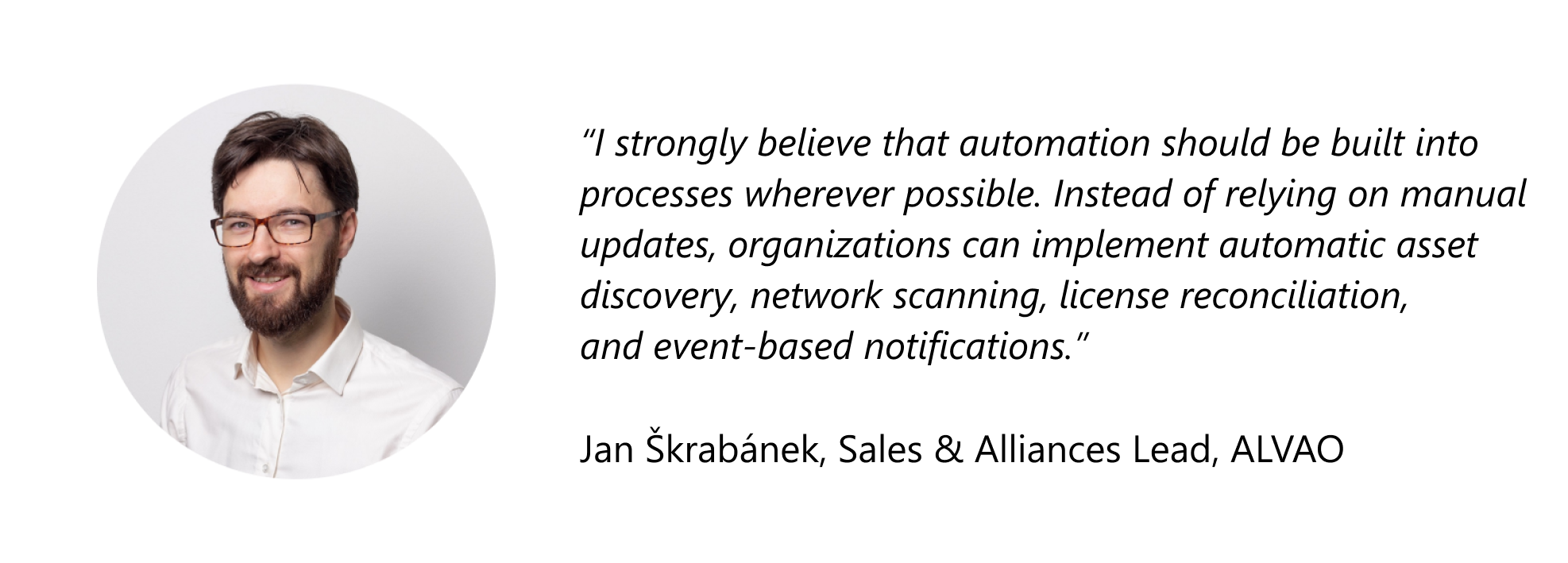
These capabilities drastically reduce the administrative load and help keep the asset database up-to-date without requiring constant manual oversight.
Turning Tracking Tools into Business Value
At the heart of all this, though, is accountability. ITAM can’t be a side project. It needs an owner. Whether that’s a full-time asset manager or a designated member of the IT team, someone must be responsible for making sure that assets are tracked, policies are followed, and updates are logged. This also extends to end users; onboarding and offboarding processes should clearly communicate asset expectations, including responsibilities for returning equipment and reporting issues.
Last but not least, IT leaders need to speak the language of the business when advocating for ITAM to reduce unnecessary spending, preventing avoidable security risks, accelerating support tickets, and showing environmental responsibility through better device reuse. Framing ITAM as a cost-saving, risk-reducing, compliance-enabling function is really important to getting leadership buy-in.
So if your team is still relying on scattered spreadsheets to manage critical IT infrastructure, this is your sign to stop and sharpen the axe. You’ll save time, save money, and sleep a lot better knowing exactly where your assets are, and who’s accountable for them.
Are you interested in efficient IT Asset Management? Do you want to gain control over your IT assets? Don’t hesitate to ask for a free 30-day trial.